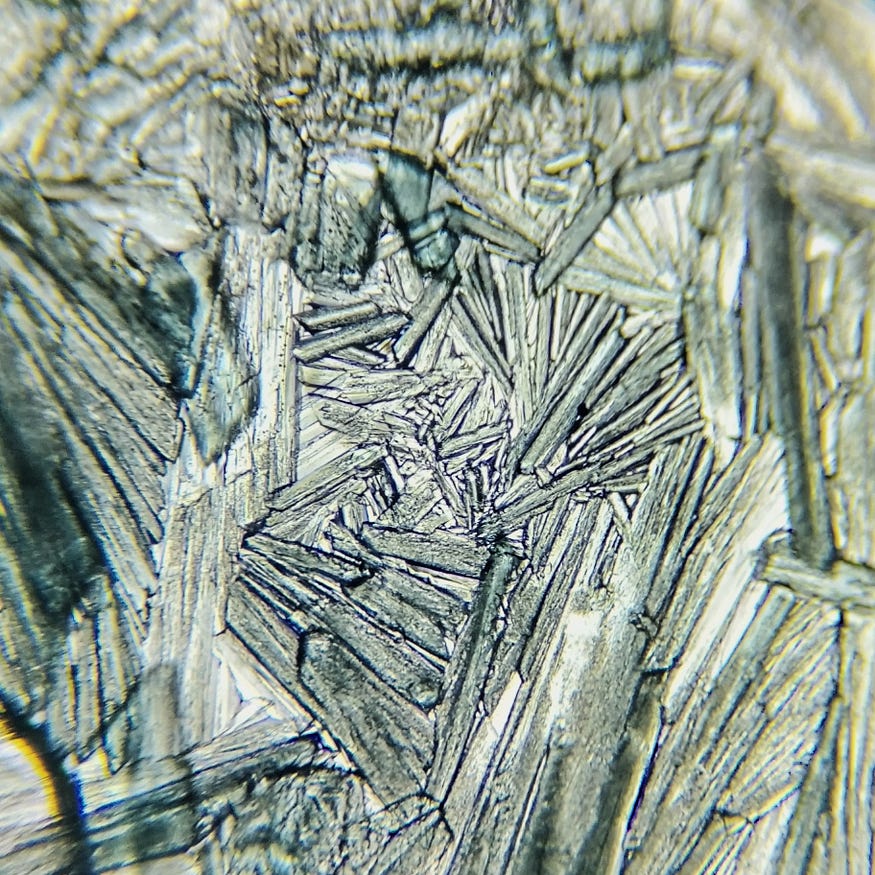
Exotic, otherworldly Copper Sulfate crystals under the microscope
Crystals are amazing. They were the whole reason I took up microscopy in the first place. My very first microscopy specimens were homemade crystals of various compounds, and they were immensely rewarding.
Since then, however, I’ve strayed quite a bit from crystal making and leaned into some unconventional microscopy. Microscopes, anyone will agree, are dope and it’s difficult to resist the temptation to put anything and everything under its prying lenses.
Nevertheless, a return to basics is long overdue.
Today, I have for you, recrystallized copper sulfate crystals (again).
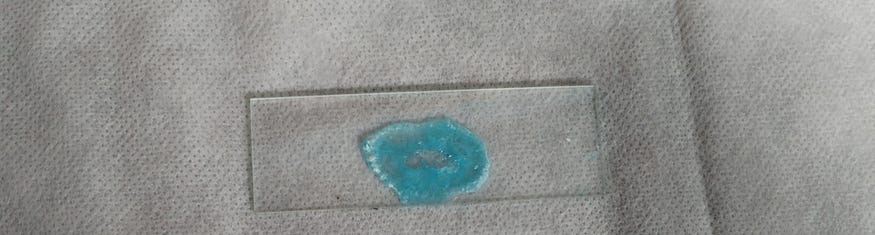
Specimen, recrystallized copper sulfate crystals, no magnification:
A few drops of copper sulfate solution were placed on a slide and slowly heated over a spirit flame, which caused the water to quickly evaporate, leaving larger crystals behind. Notice how there is a blank spot in the middle. That is where the flame hit, and the heat pushed the solution outwards.
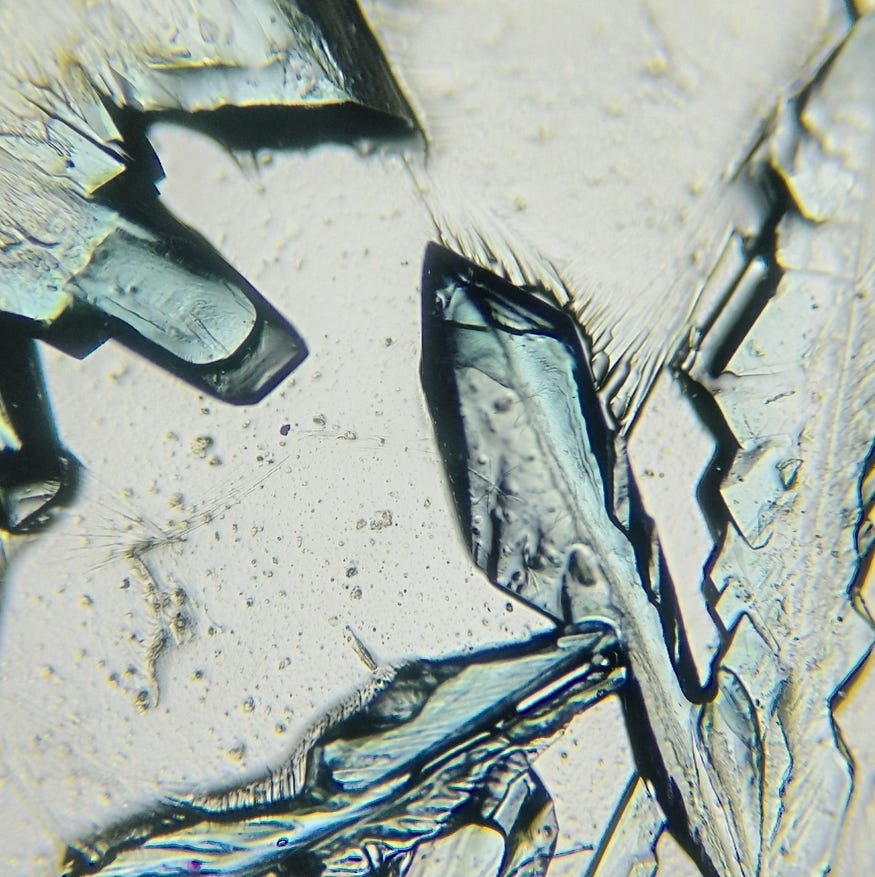
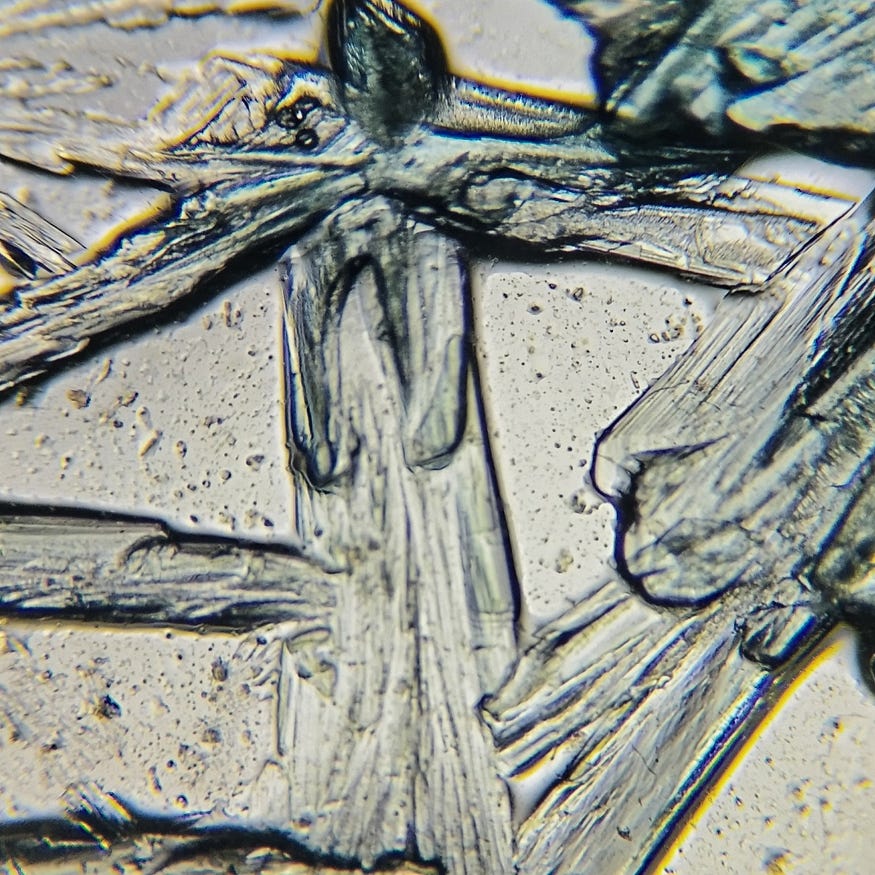
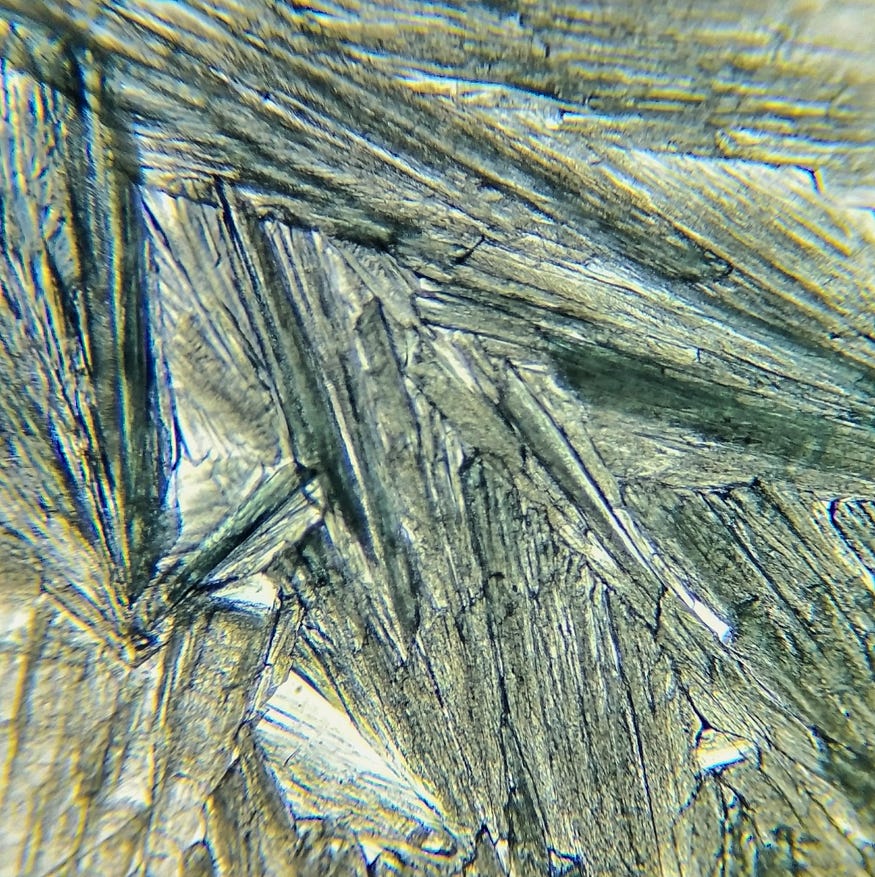
All following images were taken at 40x magnification.
Look at the pattern, the shards, the jagged edges, and the elevation of the top crystals. Look at the hint of blue, the spot of color at the top. Look at the fragility of the bottom half, like glass, the wavelike progression, the tiny inconsistencies.The crystals are like blades, but even more than the sharp edges, I like the texture, the slight ripples, and the impurities encapsulated in the little dots.Sometimes the patterns look straight up otherworldly; strange, yet mesmerizing. Notice how each blade forms from a common nucleus, a point of origin. Notice, also, at the top left, a little nubbin that attempted to go up, but did not succeed.I love repeating patterns. A bit blurry; slightly messy and chaotic. The color is off, the crystals crisscross, jumble up, and get caught up in each other. The shards are thin and not particularly healthy. Nonetheless, the pattern is pretty, at least to my eyes.A flatter area where the flame hit directly (center of slide). All the liquid was pushed outwards by the heat, leaving just a film, a crust, of light-blue crystals. Notice the dark spots scattered throughout, those are patches of Copper Oxide formed as the Copper Sulfate decomposed under excess heat.Notice the color here. The streak of relatively deep blue inside; the translucent parts; the dark and shadowy sections; the bright, white background. The crop factor takes away some of the details. It’s cleaner, but too close to the camera. It also adds a level of ambiguity. We’re focusing on the subject, but now lack the surroundings and the context.Look at the middle, the interplay of the tiny crystals. How they converge, getting smaller and smaller until they are barely discernable. They are all long, thin, narrow, and pale-colored. I couldn’t get the characteristic blue of copper sulfate in this run, but I don’t wish I had, they’re lovely as they are.
Procedure:
Make a batch of concentrated Copper Sulfate solution by dissolving excess copper sulfate into distilled water. Then place a few drops on a microscope slide and hold it carefully over a spirit flame. Keep it at a low boil; remove the slide from the flame if it starts sizzling. This prevents the copper sulfate from thermally decomposing. The slower this process the better.
When done, allow the slide to cool, and view it under low power.
All images were viewed with a compound, light microscope at 40x total magnification. Images were taken with a midrange phone camera and cropped. In some cases, filters were used to make the color pop.